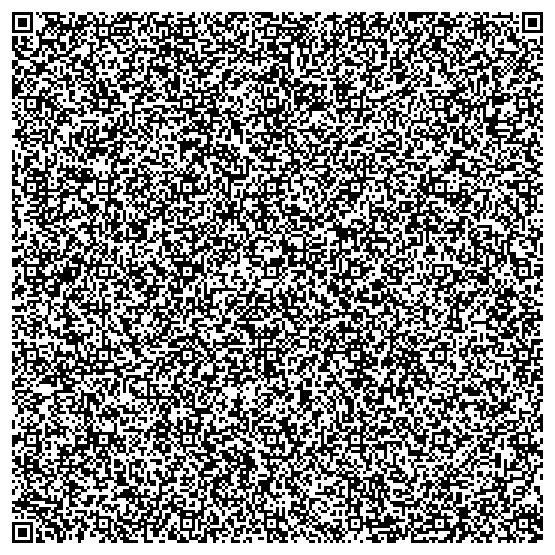
2945 bytes. Less than 0.006% of Wasmtime, smaller than a C “Hello, world!”.
Zero dependencies, no cheating: just a static x86-64 Linux executable. Scan the QR code above with zbarimg --raw -Sbinary or another QR decoder that supports binary data, or directly download the program from the GitHub repo, and you’re good to go.
Here’s me playing the Rust guessing game, cross-compiled for Wasm:

And here’s me running QuickJS, straight from official releases:

The interpreter implements the entire Lime1 Wasm feature set, and a chunk of WASI sufficient for these programs. It’s not quite feature-complete, it’s slow, and it’s insecure – but it’s still a marvelous feat of engineering with reasonable capabilities.
I had insane fun working on it, and now I want to share what made this possible.
Thanks to:
QR codes can contain up to 2953 bytes. If the project was any simpler, I’d just use assembly – but that has a disastrous effect on velocity, which is crucial for an open-ended project that requires constant experimentation and sweeping changes.
Herding gcc with -Os -fno-align-functions -fno-align-jumps -fno-align-labels -fno-align-loops -fno-jump-tables -fno-asynchronous-unwind-tables -fomit-frame-pointer helps, but not when the simplest C program is already too large. The issue is not the language, but metadata: symbols, ELF sections, dynamic linking. The headers are tiny, but they add up, and at this scale each one has to be abolished.
A linker script can merge almost all sections – code, globals, constants – into one, dropping unnecessary alignment from the binary. This makes code writeable and data executable, but security was never a goal in this experiment.
ENTRY(_start)
OUTPUT_FORMAT(elf64-x86-64)

SECTIONS {
    . = 0x400000;
    .text : {
        *(.text .text.* .data .data.* .rodata .rodata.*)
    }
    .bss : {
        *(.bss .bss.*) *(COMMON)
    }
    /DISCARD/ : {
        *(.note.*)
    }
}
strip --strip-section-headers removes symbol information and section info, retaining only segments – a crude approximation sufficient for the kernel to run the program.
Linking libc is expensive. libc does two things: initializes the program and invokes syscalls. In most operating systems, only libc knows how to do this, but Linux offers a stable userland ABI. You only need 23 bytes of machine code to wrap main:
asm (
    ".globl _start;"
    "_start:"
    "pop %rdi;" // argc
    "mov %rsp, %rsi;" // argv
    "lea 8(%rsi,%rdi,8), %rdx;" // envp
    "call main;"
    "mov $60, %eax;" // exit
    "xor %edi, %edi;"
    "syscall;"
);
This is inline assembly, and you’ll need to get used to it, because in sizecoding it’s everywhere. Invoking syscalls, like read, is as simple as:
long rax = SYS_read;
asm volatile ("syscall" : "+a"(rax) : "D"(fd), "S"(buf), "d"(count) : "rcx", "r11", "memory");
return rax;
x86 also has a party trick up its sleeve: legacy CISC instructions. memcpy, memset, strlen, and all that jazz can each be implemented with a single 2-byte rep instruction.
These features make x86/Linux the best combination for this project – x86-64, more specifically, since Wasm needs 64-bit operations. This is unlike demos, which usually target Windows or older architectures because they use a different set of features.
This forms a 200-byte clean slate. Now what?
To execute a Linux ELF program, you only need to parse headers, map segments to memory, and jump to the entry point. Dynamic linking is only slightly harder. Wasm is not like that – it has a multitude of different sections describing various moving parts:
_start function.Parsing this takes 800 bytes, or 25% of the quota down the drain before executing code. And that’s already after some optimization! So here’s the first one of many unorthodox tricks I used.
Wasm programs import syscalls as external functions, like environ_get or fd_read. Simple interpreters store the names as strings, but I store hashes instead – collisions are not an issue because the WASIp1 interface is closed.
x86 has instructions for CRC32, and for syscall names, hashing the first 8 bytes of the name and its length gives a collision-free hash at the cost of a single instruction.
Hashes can then be resolved to implementations with flat maps. But of which layout?
// Interleaved keys and values?
struct key_value {
    unsigned short key;
    unsigned short value;
};
struct key_value table[20];

// Or separate keys and values?
unsigned short keys[20];
unsigned short values[20];
C++ uses the former, but the latter is both faster (if using vectorization) and shorter: repne scasw (the x86 generalization of memchr) can locate the key in just two bytes.
What’s the first instruction in an average Wasm program? i32.const? call? Nope, it’s block, and it’s worse than you might think.
CPUs implement control flow as conditional jumps to instruction addresses. Wasm begs to differ. Wasm functions are trees with high-level constructs, like if and loop. Instead of jumping, you can continue a loop (jumping to its beginning) or break from a block (jumping to its end). With enough nesting, any control flow can be simulated.
Jumps look like br <level>, where <level> specifies how many blocks to exit. Typical interpreters analyze the code before execution to know which instruction each jump targets. Since Wasm instructions are variable-length, this requires two functions per opcode: “parse” and “execute” – a luxury we can’t afford. But there is a workaround:
const char *p; // global code pointer, adjusted by `read_uint` and other parsers

void local_get() {
    unsigned long idx = read_uint();
    // If `parsing_mode` is `true`, we parse the instruction and quit. Otherwise, we execute it
    // after parsing.
    if (parsing_mode) {
        return;
    }
    push(locals[idx]);
}
Single-pass execution saves even more code. Instead of a bool, I maintain an integer break_level. If it’s 0, code is executed normally. Otherwise, instructions are only parsed. It’s set by br and decremented on each block exit. This mechanism powers block, loop, if, else, and return, implementing control flow with little size overhead.
Is it slow? Sure, since it constantly reparses code it doesn’t execute – look at how laggy QuickJS is. But the beauty of it is that for once I don’t care about performance.
You’re already familiar with the globals p (code pointer) and break_level (parsing/execution mode), which have to be accessed by every single instruction handler:
unsigned char *p;
unsigned break_level;
Accessing globals stored in memory takes space, but x86-64 has registers to spare:
register unsigned char *p asm ("r12");
register unsigned break_level asm ("r14");
Yes, this syntax works for globals, at least on GCC – you don’t need to write all handlers in assembly just to pass data through registers. This saves about 500 bytes.
With Wasm peculiarities out of the way, we can actually execute instructions:
while (*p != 0x0b /* end */) {
    opcode_map[*p++]();
}
Let’s take a look at memory loads for example. There are loads of them:
i32.loadi64.loadf32.loadf64.loadi32.load8_si32.load8_ui32.load16_si32.load16_ui64.load8_si64.load8_ui64.load16_si64.load16_ui64.load32_si64.load32_uIndividually, each handler needs little code, but it’s better to write a single complex function than 14 small ones, since they add up. The multitude of opcodes can be implemented by a 64-bit read followed by variable shifts, with amount depending on bitness and arithmetic/logical shifts depending on sign- or zero-extension:
void load(unsigned char opcode) {
    // ...
    int d = 64 - bitness;
    value <<= d; // shift out unused bits
    if (opcode % 2 == 0) { // signed or pure 32-bit
        value = (long)value >> d; // return the bits to the correct position with sign-extension
        if (opcode < 0x30) { // 32-bit destination
            value &= -1U; // clear top 32 bits
        }
    } else { // unsigned or pure 64-bit
        value >>= d; // return the bits to the correct position with zero-extension
    }
    // ...
}
Sign-extension is simple, but the shift amount is hard to calculate from opcode without using a LUT. The same situation arises in other operations, and so the cheapest way to do this is to integrate a general-purpose LUT into the opcode map:
void load(unsigned char opcode, unsigned char d) {
    // ...
}

while (*p != 0x0b /* end */) {
    unsigned char opcode = *p++;
    opcode_map[opcode].handler(opcode, opcode_map[opcode].arg);
}
You’ll see this utilized more soon.
Let’s focus on unary operations for now. Their handlers have the same structure:
if (break_level > 0) {
    return;
}
unsigned long value = *stack_head;
// ...
*stack_head = value;
Reusing the boilerplate with switch (opcode) is suboptimal. A hand-written jump table with the branch offset in arg is smaller than any pure-C alternative can be:
asm (
    "jmp *%[handler];"
    "unop_handlers:"
    "unop_clz32: lzcnt %k0, %k0; jmp 1f;"
    "unop_clz64: lzcnt %0, %0; jmp 1f;"
    "unop_ctz32: tzcnt %k0, %k0; jmp 1f;"
    "unop_ctz64: tzcnt %0, %0; jmp 1f;"
    // ...
    "1:"
    : "+R"(*stack_head)
    : [handler]"r"(&unop_handlers + arg)
    : "flags"
);
This is an optimization a compiler can’t do because it’s unaware of the external LUT. Here’s one it could, but didn’t. jmp takes two bytes; ret takes only one:
asm (
    "call *%[handler];"
    ".pushsection .text.op;"
    "unop_handlers:"
    "unop_clz32: lzcnt %k0, %k0; ret;"
    "unop_clz64: lzcnt %0, %0; ret;"
    "unop_ctz32: tzcnt %k0, %k0; ret;"
    "unop_ctz64: tzcnt %0, %0; ret;"
    // ...
    ".popsection;"
    : "+R"(*stack_head)
    : [handler]"r"(&unop_handlers + arg)
    : "flags"
);
This tiny change saves about 30 bytes – mere crumbs in all other circumstances, but since the final result is just 8 bytes below the limit, even this minor thing matters.
Assembly paves the way for trickier optimizations. Many unary ops have 32-bit and 64-bit variants, which x86 denotes by the presence of a REX prefix (here 48):
   0f be c0             movsx  eax,al ; sign-extend 8 bits to 32 bits
48 0f be c0             movsx  rax,al ; sign-extend 8 bits to 64 bits
   0f bf c0             movsx  eax,ax ; sign-extend 16 bits to 32 bits
48 0f bf c0             movsx  rax,ax ; sign-extend 16 bits to 64 bits
Real programmers overlap their branches – take that, ARM!
    "extend8_64: movsx %b0, %0; ret;"
    "extend8_32 = extend8_64 + 1;"
sqrt and float double conversion use a different encoding, breaking this trick:
f3 0f 51 c0             sqrtss xmm0,xmm0 ; float sqrt
f2 0f 51 c0             sqrtsd xmm0,xmm0 ; double sqrt
f3 0f 5a c0             cvtss2sd xmm0,xmm0 ; float -> double
f2 0f 5a c0             cvtsd2ss xmm0,xmm0 ; double -> float
But the corresponding vectorized operations save the day. x86 never fails to surprise.
   0f 51 c0             sqrtps xmm0,xmm0
66 0f 51 c0             sqrtpd xmm0,xmm0
   0f 5a c0             cvtps2pd xmm0,xmm0
66 0f 5a c0             cvtpd2ps xmm0,xmm0
Not all instructions are as simple. Wasm comparisons map nicely to the x86 setcc instructions – sete, setl, setae – which encode the operation in the middle byte:
0f 94 c0                sete   al ; a = b
0f 9c c0                setl   al ; a < b, signed
0f 93 c0                setae  al ; a >= b, unsigned
Funclets would take four bytes per opcode, but patching a function’s x86 code in runtime – a rudimentary form of JIT – brings overhead down to a constant:
asm (
    "cmp $0x51, %[opcode];"
    "jb 1f + 1;" // if 32-bit, skip over the REX prefix in `cmp`
    "1: cmp %[b], %[a];" // perform 64-bit comparison
    "mov %[arg], 2f + 1(%%rip);" // patch the setb instruction, taking the byte from `arg`
    "2: setb %[out]" // this is actually arbitrary setcc
    : [out]"=R"(out)
    : [a]"R"(a), [b]"R"(b), [arg]"r"(arg), [opcode]"r"(opcode)
    : "flags"
);
Self-modifying code has troublesome effects on performance, but we’ve burned that bridge a long time ago – it can’t be that bad in comparison to constant reparsing.
Floating-point rounding also benefits from patching, even though the rounding direction can be set in a global flag – patching code turns out to be cheaper.
Next up: float-to-int conversions. These support four destination types: i32, u32, i64, and u64. They look similar, but their implementations are completely different:
fn f64_to_i32(x: f64) -> i32 { x as _ }
fn f64_to_u32(x: f64) -> u32 { x as _ }
fn f64_to_i64(x: f64) -> i64 { x as _ }
fn f64_to_u64(x: f64) -> u64 { x as _ }
f64_to_i32:
xor eax, eax
ucomisd xmm0, xmm0
maxsd xmm0, 0xc1e0000000000000
minsd xmm0, 0x41dfffffffc00000
cvttsd2si ecx, xmm0
cmovnp eax, ecx
ret
f64_to_u32:
xorpd xmm1, xmm1
maxsd xmm1, xmm0
movsd xmm0, 0x41efffffffe00000
minsd xmm0, xmm1
cvttsd2si rax, xmm0
ret
f64_to_i64:
cvttsd2si rax, xmm0
ucomisd xmm0, 0x43dfffffffffffff
mov rcx, 0x7fffffffffffffff
cmovbe rcx, rax
xor eax, eax
ucomisd xmm0, xmm0
cmovnp rax, rcx
ret
f64_to_u64:
cvttsd2si rax, xmm0
mov rcx, rax
sar rcx, 63
movapd xmm1, xmm0
subsd xmm1, 0x43e0000000000000
cvttsd2si rdx, xmm1
and rdx, rcx
or rdx, rax
xor ecx, ecx
xorpd xmm1, xmm1
ucomisd xmm0, xmm1
cmovae rcx, rdx
ucomisd xmm0, 0x43efffffffffffff
mov rax, -1
cmovbe rax, rcx
ret
Parts of Rust’s generated code are suboptimal, overall the distinctions are justified:
x86 returns 0x80...00 on out-of-bounds conversions, Wasm enforces saturation. For signed conversions, this constant is by pure luck the precise lower bound – but the upper bound still needs to be handled explicitly.
f64_to_i32 clamps the input double with min(x, 2^32 - 1). f64_to_i64 can’t do that because 2^64 - 1 doesn’t fit in f64 precisely – and rounding would cause cast(+inf) to return 2^64 - 2048 instead of 2^64 - 1.
For unsigned conversions, max(x, 0) sets the lower bound. This also converts NaN to 0, as mandated by Wasm, since x86 defines min(NaN, a) = a. Signed conversions still require explicit NaN handling.
x86 only supports signed conversions. u32 can be emulated with i64 because it always fits; large u64 values need to be handled manually.
Handling this complexity in a single generic function is an exercise in ingenuity.
First, I generate the double representation of the upper bound on the fly:
unsigned bitness = 31 + (arg & 1) + 32 * ((arg & 4) != 0);
unsigned long upper_bound = (1023UL + bitness) << 52; // pow2(bitness), actually `double`
min fails for f64_to_i64, so it’s not worth doing – better compare x < upper_bound and manually handle the too-high case. x86 reports whether x is NaN as a side effect of comparison. GCC codegen can’t utilize it, so inline assembly has to be used:
asm goto (
    "ucomisd %1, %0;"
    "jp %l2;"
    "jb %l3;"
    :
    : "x"(x), "x"(upper_bound)
    : "flags"
    : maxsd, below_limit
);
Note the jump to maxsd on NaN – the instruction x = max(x, 0) used by unsigned conversion can be abused to convert NaN to 0 for signed integers as well.
below_limit:
if (arg & 1) { // unsigned
maxsd:
    asm ("maxsd %1, %0" : "+x"(x) : "x"(0L));
}

// 32-bit or 64-bit signed conversion
asm ("cvttsd2si %1, %0;" : "=r"(out) : "x"(x)); // everything but i32 is converted as i64
if (arg == 0 || arg == 2) {
    asm ("cvttsd2si %1, %k0;" : "=r"(out) : "x"(x)); // i32 is converted as i32
}
Built-in signed conversion suffices for everything but u64 values between 2^63 and 2^64 - 1. Not to worry: IEEE-754 doubles in this range can be converted by hand:
if ((arg & 1) && (long)out < 0) { // intended destination u64, and i64 conversion failed
    unsigned long value;
    __builtin_memcpy(&value, &x, 8);
    out = (value << 11) | (1UL << 63); // move mantissa to the right position, set hidden bit
}
Float-to-int conversions could convert float inputs to doubles to halve code size. Not so easy in the other direction: (float)n and (float)(double)n can produce different results because both steps in the i64 double float chain introduce rounding.
Duplication or code patching is necessary. Or is it?
The x87 FPU uses 80-bit long doubles, which barely fit all i64s without rounding. Who knew FPU could be useful? Typed loads and stores reduce case handling further:
// Load
long double ld;
if (arg == 1) { // load s32 as s32
    asm ("fildl %1" : "=t"(ld) : "m"(*stack_head));
} else { // load other types as s64
    asm ("fildq %1" : "=t"(ld) : "m"(*stack_head));
}

// Store
*stack_head = 0;
if (opcode < 0xb7) { // f32
    float f = ld;
    __builtin_memcpy(stack_head, &f, 4);
} else { // f64
    double d = ld;
    __builtin_memcpy(stack_head, &d, 8);
}
Large u64s misparsed as i64s can be fixed simply by adding 2^64 to the float, a trick I stole from GCC’s codegen:
if (arg == 2 && (long)*stack_head < 0) { // u64 and misparsed
    ld += 0x1p64;
}
I’ve only applied unconventional, but textbook methods so far. This one is different.
Wasm defines min and max like this:
NaN argument, the result is NaN.-0 is considered less than +0.x86 defines min and max like this:
NaN argument, the result is the second argument.-0 and +0 are considered equal, with ties resolved to the second argument.It’s a subtle difference, but I want to make a standards-compatible interpreter, not something that works for two apps. Implementing min or max individually is doable:
fn wasm_min(x: f64, y: f64) -> f64 {
    if x /* unordered */ y {
        // There must be a NaN -- produce NaN as an output. Addition is cheaper than a constant.
        x + y
    } else if x == y {
        // Either same value, or -0 and +0. For the former, `|` is a no-op. For the latter, the
        // sign bit is set to negative if either argument is negative.
        f64::from_bits(x.to_bits() | y.to_bits())
        // For max: f64::from_bits(x.to_bits() & y.to_bits())
    } else if x < y { // for max: x > y
        x
    } else {
        y
    }
}
When merged into one handler, this requires patching two locations:
or and and.x < y and x > y.Only one patch can use the opcode LUT, leaving the other to calculate a constant. But there’s an alternative. In x86, comparison is a two-step operation:
cmp a, b stores compressed results of all possible comparisons in flags.jcc target parses flags and jumps if the right condition is satisfied.The result of “less” comparison is stored in the carry flag. If we could just invert it between cmp and jcc if the operation is max, we could avoid patching code.
Saving the flag to a register to xor it is too wasteful – we need to operate on flags directly. cmc inverts the carry flag unconditionally, but skipping it on min requires comparing the opcode, which clobbers the carry flag. So we need another way.
adc a, b computes a + b + carry and, among others, sets the zero flag if the result is 0. If we could set arg = -1 for min and arg = 0 for max, then adc arg, 0 would set ZF on min + set carry (x < y) and on max + no carry (x >= y) – the combination we need.
But arg is not free: it needs to be 0xeb for min and 0xdb for max due to patching between or and and, and these values are too far for ZF to work. However, the legacy parity flag, set if the number of 1 bits in the bottom byte of the result is even, remains receptive to small changes:
0xeb + 5 + 0 has 4 set bits (even).0xeb + 5 + 1 has 5 set bits (odd).0xdb + 5 + 0 has 3 set bits (odd).0xdb + 5 + 1 has 4 set bits (even).; valid for min
jc output_x
; valid for max
jnc output_x
; valid for both
adc arg, 5
jnp output_x
This is the first time I’ve used PF, and only the second time I’ve seen it in codegolf.
Calculations without side effects are not terribly interesting. Let’s talk about syscalls. fd_read is the most interesting one, since its implementation has to convert data between arrays of native and WASI structures:
struct wasi_iovec {
    unsigned buf;
    unsigned buf_len;
} *src;

struct iovec {
    void *iov_base;
    size_t iov_len;
} *dst;
Here’s a converter written by a noob, requiring four manual memory accesses:
for (unsigned i = 0; i < count; i++) {
    dst->iov_base = memory + src->buf;
    dst->iov_len = src->buf_len;
    src++, dst++;
}
Here’s one written by a pro, using x86’s ancient stream reading/writing instructions:
for (unsigned i = 0; i < count; i++) {
    asm volatile (
        "lodsl;" // src->buf
        "add %[memory], %%rax;"
        "stosq;" // dst->iov_base
        "lodsl;" // src->buf_len
        "stosq" // dst->iov_len
        : "+S"(src), "+D"(dst)
        : [memory]"i"(memory)
        : "rax", "memory"
    );
}
lodsl reads 4 bytes and increments the input pointer. stosq stores 8 bytes and increments the output pointer. This saves 16 bytes – huge for a simple change.
Are these thorough optimizations and hand-written assembly enough? Nope: at this point, the interpreter exceeds 4500 bytes. But I have an ace up my sleeve.
Demosceners are used to packing their demos. Programs compressed with tools like Crinkler don’t just use external decoders like gzip – that would be cheating, and compression ratio suffers anyway. Instead, it packs a fine-tuned entropy decoder written in assembly. It’s a little slow to decode, even slower to encode, and requires plenty of memory, but it gets the job done.
But Crinkler targets 32-bit Windows, while I’m using 64-bit Linux. And I can’t change this: wasting space on 64-bit arithmetic sucks as much as importing syscalls from NTDLL. I needed a new Crinkler, and the lazy bum I am, I poked Yuki to do it for me.
The details are a little too technical, so I won’t cover them in the entirety – if you’re interested, this post covers the Crinkler design, which is very similar to ours.
In a nutshell, we’re compressing concatenated text and data with arithmetic coding, loading it with a small bootstrapping decoder and jumping to it. The probabilities are computed with linear context mixing according to static models that are brute-forced by the encoder. We operate on bit granularity, and predictors use a shared 8 MiB hash table with CRC32 as the hash function. We also perform the E8 transform.
Notable differences from Crinkler are:
c0 and c1 and halve the wrong counter, instead of incrementing the correct one and (saturate-)halving the wrong one.These choices are not necessarily the best for every situation, but we found they worked well here. There’s likely a way to save 30-ish bytes, but there’s little more we could fit in that space, so we decided to call it quits.
Overall, this reduces code size by about 40%. This shows how redundant x86 code is, but it’s also close enough that we had to tweak a few parameters to get it to fit.
The actual story was much less linear than described here, but this post is already quite long, and I fear I’ll bore people if I discuss more minutiae. If you’re interested in more detail, I wrote down a development log.
This project was a lot of fun to me (insomnia excluded), and it was a nice change of pace compared to my usual performance-related work. It was cool to see old techniques find their place in modern computing, like the parity flag, the x87 FPU, self-modifying code, and writing jump tables by hand.
The interpreter is released on GitHub in all of its glory. It’s called autumn because the punny name winter was already taken, and autumn is kinda like autistic winter. Supported features pass tests from the Wasm spec, though traps and validation aren’t implemented, so e.g. memory accesses can go out of bounds, type checks are absent, and parsing can crash. If it wasn’t clear by now, don’t use this in prod.
I hope this was fun to read. Maybe it’ll motivate you to try size coding as well!
